_edited.png)
Trans in Classics is a working group of the SCS that seeks to provide a community and source of advocacy for trans* (transgender, nonbinary, and gender-expansive) folx within Classics and to promote and produce scholarship that discusses trans-identities, issues, and readings.
This group works to bring some of the insights and lived experiences found in Transgender Studies into conversation with the Classics in the hope that bringing them together will enrich both our pedagogy and students’ lives, while also centering our academic conversations within an ethics of care that includes and nourishes trans lives.
We encourage all students and scholars who are members of the trans* community (most broadly construed) to join our mailing list, and to contact us directly to get involved, join social events, or find mentorship and other resources. We also welcome cisgender allies, and we invite scholars, teachers, & mentors who wish to engage more confidently with trans issues to join our mailing list and to contact us directly with any inquiries.
Please Contact Us if you are interested in:
• Joining us as a volunteer or regular member
• Sponsoring an event
• Consulting about a scholarly project
• Finding mentorship or guidance
• Requesting a sensitivity reading
• Inviting a speaker
• Learning more about any of our projects or events
Visit our Community Guidelines below to review our organization policies for responsible participation in Trans in Classics social & academic programming.
Fill the form below to sign up for Trans in Classics' mailing list, where you will receive notifications about community events & stay up to date on Trans Studies in Classics.
Sign Up Here
transinclassicsorg@gmail.com

nick.winters@northwestern.edu
kgm3@illinois.edu
.avif)
jperroni@wisc.edu

rchilds@uwaterloo.ca
 The 2nd International Trans Studies Conference
Registration is open for the International Trans Studies Conference!
 Guest Podcast: Julia Perroni on Let's Talk About Myths, Baby!
Julia Perroni & Liv Albert discuss queer theory & Circe in Homer's Odyssey.
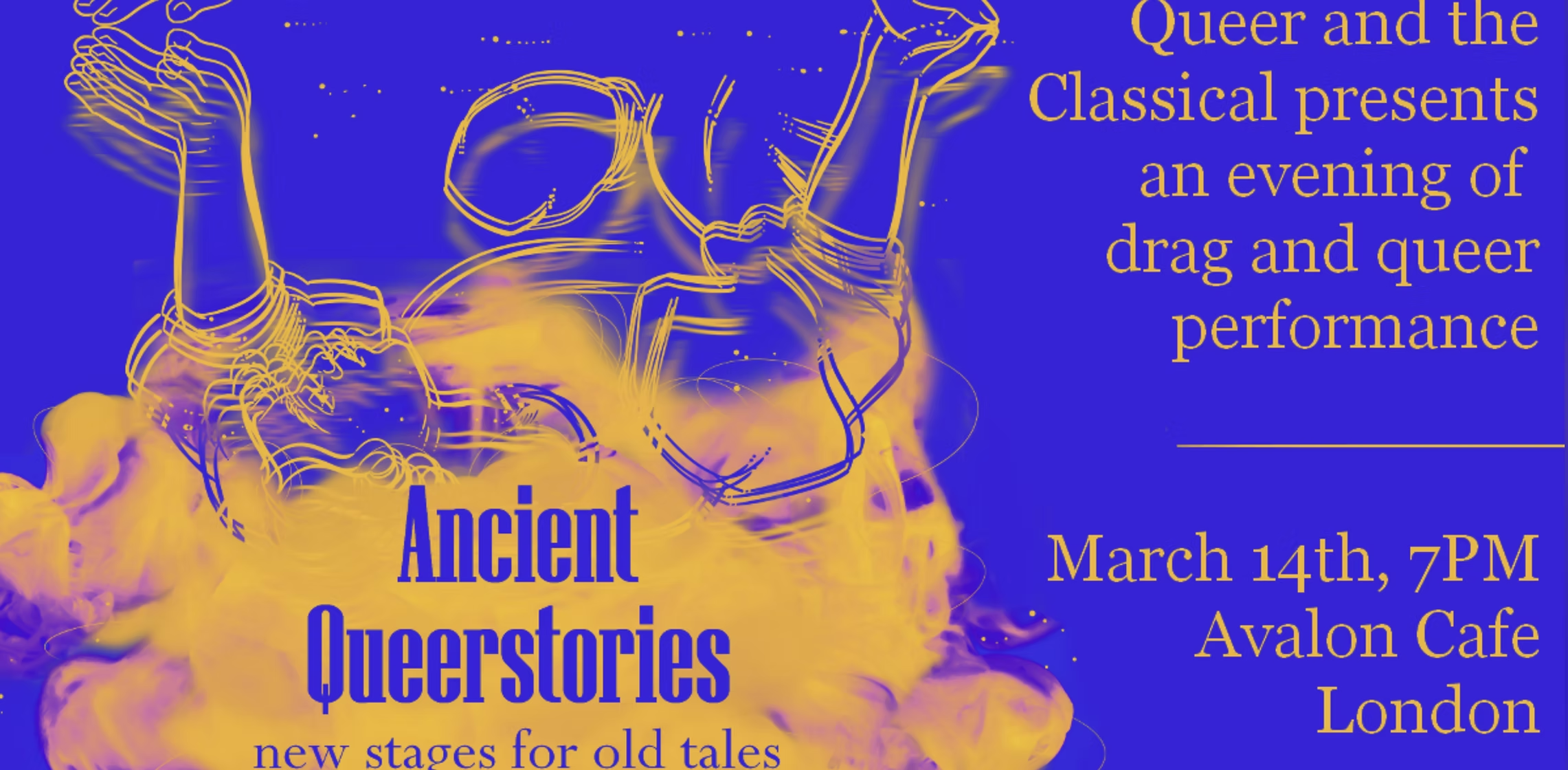 Ancient Queerstories: New Stages for Old Tales
March 14th: Queer and the Classical for "an evening of drag and queer performance" (2024)
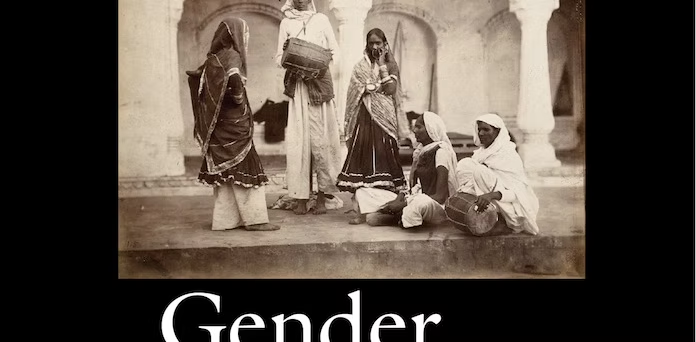 Showcasing a recent publication on writing trans histories in the Roman Empire
Ky Merkley, "Writing Trans Histories with an Ethics of Care While Reading Gender in Imperial Roman Literature"
This page serves as a general resource page for rules, ethics and best practices adopted and enforced by Trans in Classics as an organization. We ask that you please review these guidelines carefully.
We as members pledge to make participation in our community a harassment-free experience for everyone, regardless of age, body size, visible or invisible disability, ethnicity, sex characteristics, gender identity and expression, level of experience, education, socio-economic status, nationality, personal appearance, race, religion, or sexual identity and orientation.
We pledge to act and interact in ways that contribute to an open, welcoming, diverse, inclusive, and healthy community.
This Code of Conduct applies within all community spaces, and also applies when an individual is officially representing the community in public spaces.
Examples of representing our community include using an official email address, posting via an official social media account, or acting as an appointed representative at an online or offline event.
This Code of Conduct is adapted from the Contributor Covenant, version 2.0, available at https://www.contributor-covenant.org/version/2/0/code_of_conduct.html.
Community Impact Guidelines were inspired by Mozilla’s code of conduct enforcement ladder. For answers to common questions about this code of conduct, see the FAQ at https://www.contributor-covenant.org/faq. Translations are available at https://www.contributor-covenant.org/translations.
Demonstrating empathy and kindness toward other people
Being respectful of differing opinions, viewpoints, and experiences
Giving and gracefully accepting constructive feedback
Accepting responsibility and apologizing to those affected by our mistakes, and learning from the experience
Focusing on what is best not just for us as individuals, but for the overall community
The use of harmful sexualized language or imagery, and unwanted or unwarranted sexual attention or advances of any kind including, but not limited to, behavior that is considered exploitative, harassing, fetishizing, threatening, soliciting, or objectifying, a personal enactment of sexual gratification, or violating an individual’s privacy
Trolling, insulting or derogatory comments, and personal or political attacks
Public or private harassment
Publishing others’ private information, such as a physical or email address, without their explicit permissionOther conduct which could reasonably be considered inappropriate in a professional setting
Community leaders are responsible for clarifying and enforcing our standards of acceptable behavior and will take appropriate and fair corrective action in response to any behavior that they deem inappropriate, threatening, offensive, or harmful.
Community leaders have the right and responsibility to remove behavior and actions that are not aligned with this Code of Conduct, and will communicate reasons for moderation decisions where appropriate. Examples include but are not limited to removing and editing comments, muting and removing participants from text or voice channels, and banning individuals from inperson events.
Instances of abusive, harassing, or otherwise unacceptable behavior may be reported to the community leaders responsible for enforcement at transinclassicsorg@gmail.com or via direct message to one of the Trans in Classics Discord moderators.
All complaints will be reviewed and investigated promptly and fairly.Community leaders will have the discretion to escalate the severity of consequences for inappropriate behavior based upon the nature of the situation.
All community leaders are obligated to respect the privacy and security of the reporter of any incident.
Community leaders will follow these Community Impact Guidelines in determining the consequences for any action they deem in violation of this Code of Conduct:
Community Impact
Use of inappropriate language or other behavior deemed unprofessional or unwelcome in the community.
Consequence
A private, written warning from community leaders, providing clarity around the nature of the violation and an explanation of why the behavior was inappropriate. A public apology may be requested.
Community Impact
A violation through a single incident or series of actions.
Consequence
A warning with consequences for continued behavior. No interaction with the people involved, including unsolicited interaction with those enforcing the Code of Conduct, for a specified period of time. This includes avoiding interactions in community spaces as well as external channels like social media. Violating these terms may lead to a temporary or permanent ban.
Community Impact
A serious violation of community standards, including sustained inappropriate behavior.
Consequence
A temporary ban from any sort of interaction or public communication with the community for a specified period of time. No public or private interaction with the people involved, including unsolicited interaction with those enforcing the Code of Conduct, is allowed during this period. Violating these terms may lead to a permanent ban.
Community Impact
Demonstrating a pattern of violation of community standards, including sustained inappropriate behavior, harassment of an individual, or aggression toward or disparagement of classes of individuals.
Consequence
A permanent ban from any sort of public or private interaction within the community.